From Jim's Story
September 1, 2026
From a Green Bay startup to City Hall
Building Famis taught me to listen to the person closest to a problem, improve the idea, and stay with the work until people can see a result.
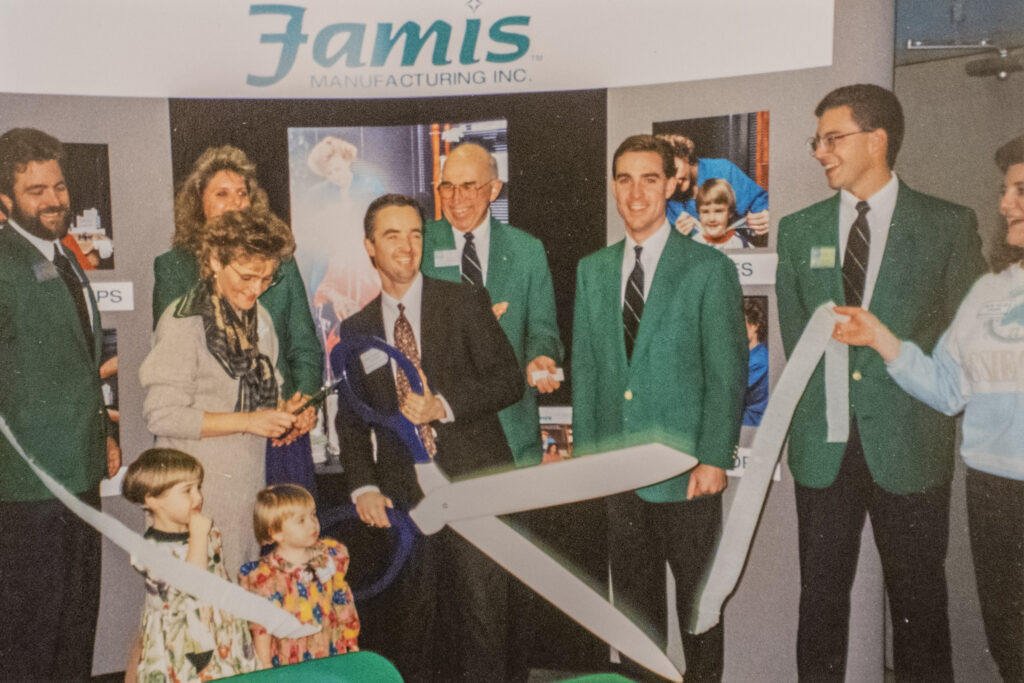
Long before I became mayor, I was trying to build a product and a business in Green Bay.
I was working in the paper industry when I was asked to research possible new product lines. Paper products were already common in medical and food-service settings, but I saw another market in barbershops and beauty salons. One of the ideas I developed was a disposable paper neck strip that could fit comfortably between a customer and a barber's cape.
The company did not pursue the idea. I still believed it could work, but belief was not enough. I understood paper manufacturing. I did not understand what happened behind a barber's chair or what a stylist needed from a product used all day, every day.
That was how I met Dona.
A friend connected me with her because she was an experienced hairdresser. She could see details I had missed. She understood how the strip needed to feel, how it would be handled, and what would make it useful rather than merely clever. Her knowledge made the product better. Our business conversations became lunch conversations, then dinners, and eventually a life together.
That experience taught me something I have never forgotten: the person closest to a problem often knows something the person with the title does not.
I started Famis Manufacturing with used production equipment in a Green Bay business incubator. The name stood for Finest at Manufacturing Innovation and Service. It began with two employees. As demand grew, we added people and equipment. Two employees became five, then six, then ten. By the time the company was sold, Famis had grown to 18 employees and approximately $3 million in annual sales.
The incubator was an important part of that beginning. We did not start with a polished factory or unlimited capital. We started with the equipment and space we could obtain, then earned the ability to grow. That experience gave me lasting respect for people who build something useful from limited resources.
Those numbers mattered because each one represented trust. A customer had to trust that the product would perform. An employee had to trust that the work would be there. A supplier had to trust that we would pay our bills. A growing business is held together by those ordinary commitments long before anyone calls it a success.
Selling Famis products also gave me a chance to see how other American cities worked. I stayed in modest hotels and walked through downtown districts in places such as Indianapolis and Denver. Some downtowns felt active and connected to their neighborhoods. Others felt hollowed out. Those trips helped me understand that a city's center is not separate from the rest of the community. What happens downtown affects how a city sees itself and how others see it.
The story eventually came full circle. The company that had declined the original idea later became a Famis customer and ultimately bought the business. I did not take that as proof that I had been right about everything. I took it as proof that an idea can improve when the right people test it, challenge it, and stay with it.
Building Famis shaped how I later approached public service.
Government is not a business, and residents are not commercial customers. Public decisions carry responsibilities that a private company does not have. But the practical habits still matter. Listen to the people doing the work. Admit what you do not know. Test an idea before scaling it. Use resources carefully. Build a team with different skills. Stay accountable for the result.
Most important, do not confuse leadership with having every answer yourself. Dona understood the customer better than I did. The employees running the equipment understood the production line better than I did. Customers showed us where the product still needed work. My job was to listen, make decisions, and help those different perspectives produce something useful.
That is the standard I carried from a Green Bay startup into City Hall. It remains the standard I believe local government should meet: listen closely, work through the details, and produce results people can see.
Why this still matters
Practical leadership starts by listening to the person closest to a problem and building a team that can turn an idea into a result.