Water, Parks, and Public Life
August 17, 2026
The unglamorous work of safer water
Green Bay reported replacing 479 lead service lines in 2018, backed by stadium-tax revenue and state loans.
Some city projects are designed to be seen. Lead service-line replacement is most successful when residents no longer have to think about what is buried between a water main and a home.
That does not make the work minor. A service line is part of the physical route that carries drinking water from the public system into a building. Replacing older lead lines requires records, inspections, coordination with property owners, street and yard access, financing, contractors, and follow-up.
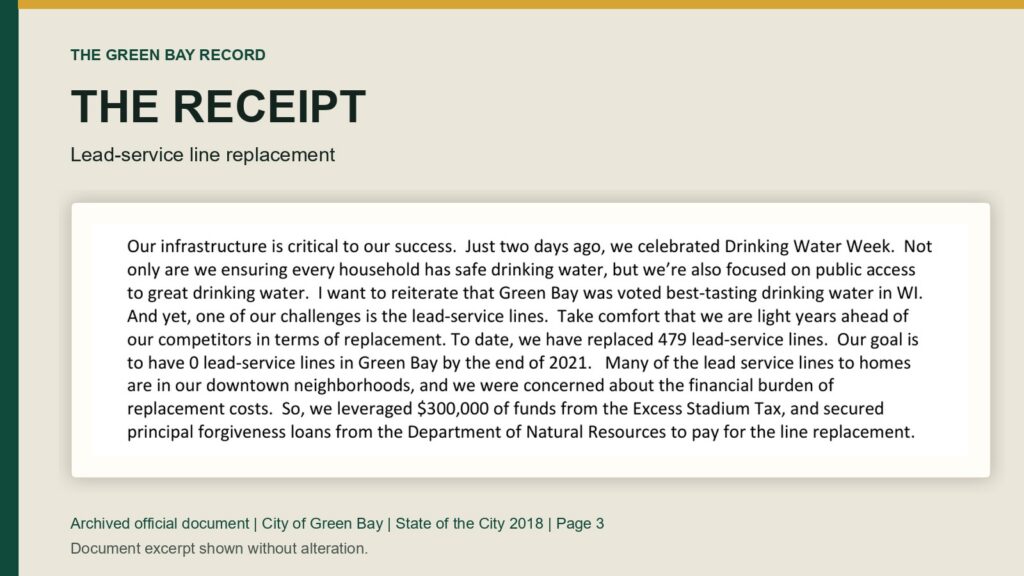
Green Bay's 2018 State of the City reported that 479 lead service lines had been replaced during that year. The city also stated at the time that it was working toward eliminating the remaining lines by the end of 2021.
The funding structure was part of the accomplishment reported in 2018. According to the city, the work used Lambeau Field sales-tax revenue and principal-forgiveness loans from the Wisconsin Department of Natural Resources. That combination reduced the burden on the local system while directing public resources toward a specific infrastructure and public-health purpose.
The historical target needs to remain described accurately. A goal announced in 2018 is not, by itself, proof that every later line was replaced on schedule. Final completion requires a later verified record. The 2018 source supports the number replaced that year, the funding identified at the time, and the city's stated plan.
Even within those limits, the work shows why municipal performance cannot be measured only by ribbon cuttings.
Each replacement involved a property, a resident, a contractor or crew, and a sequence that had to be coordinated safely. Records had to identify where older material remained. Funding had to be available. Streets or yards might be disturbed and restored. The water system had to continue operating while the work moved from address to address.
No single replacement transformed the city. Hundreds of completed replacements reduced a known infrastructure risk one property at a time.
This kind of work also depends on institutions beyond the mayor's office. The Green Bay Water Utility, council members, finance staff, state agencies, contractors, and property owners all had roles. The public record should recognize that shared responsibility.
When I look back at the city work from 2018, the 479 replacements matter because they were specific and measurable. The number was not a broad promise about health or infrastructure. It described work the city reported as completed during the year.
That is what basic public service often looks like: identify a hidden risk, assemble the funding, coordinate the people who can address it, report the progress, and keep going until the remaining work is independently documented as finished.
Why this still matters
The least visible city work can carry the greatest everyday stakes for public health and neighborhood infrastructure.